The Toll
Celeste Wright
36 chapters4.7553.1K reads
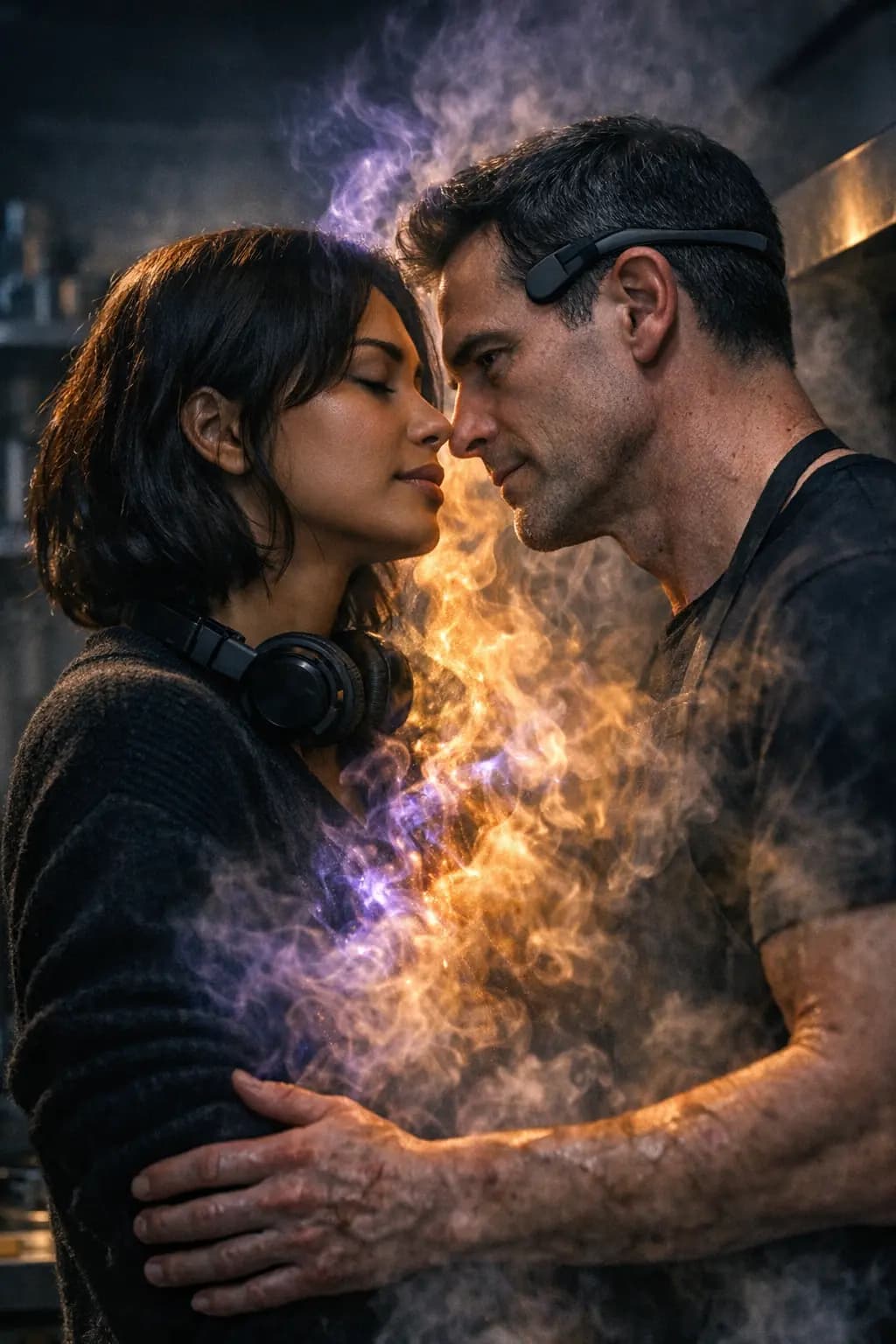
Every time you have sex, you lose a sense. He's lost three. I've lost one. And I want him anyway.
The coffee was hot in my hands. Bitter on my tongue, the good kind, the kind that meant I'd ground the beans fine enough. No scent. There was never any scent. Eight months and I still lifted the mug to my face every morning, expecting something, getting nothing.
Habit is a kind of ghost.
I set the mug on the counter and pulled my headphones on. The studio was cold this early, the soundproofing panels swallowing the radiator's heat along with everything else. I tapped the mixing board awake and the monitors lit up, waveforms from yesterday's edit still frozen on screen.
Sound was the one thing I trusted. Sound didn't lie, didn't vanish overnight, didn't get taken by some cosmic invoice nobody asked for. I could see it, too. Not the way most people see waveforms on a screen. Actually see it. The low hum of the radiator was a muddy brown. The click of my mouse, a pinprick of silver. When I played the interview back, the guest's voice unspooled in ribbons of grey-blue that used to be vivid, saturated, like stained glass in motion.
Used to be.
The synesthesia had dimmed since I lost smell. Not gone, exactly. Faded. The colors still came, but muted, like someone had washed them too many times. My neurologist called it "cross-modal disruption." I called it being robbed twice.
I listened to the interview. A Preserver spokesperson, careful and polished, explaining the "Five for Five" philosophy. Keep all five senses. The white ribbon crowd. Celibacy as survival strategy.
She was good. Clear, convincing, and not wrong, exactly. The logic was simple: don't have sex, don't lose anything. Hard to argue.
Except people aren't logic. People are bodies and loneliness and three AM decisions that make no sense in daylight. The Preservers had the argument. The real world had the mess.
I clipped the interview, tagged it, moved on. Margaux wanted the episode structure by noon.
My phone buzzed. Speaking of.
Have you found a support group yet? The Griever angle is strong. Think raw, think unflinching. Think listeners crying on the subway.
Margaux texted the way she produced: with an audience in mind.
I'm looking, I typed back.
There's one called What Remains. Meets Tuesdays and Thursdays at a community center on Birch. Multi-loss group. Two or more senses gone.
Two or more. I'd lost one and it had rearranged my entire internal architecture. Two or more was a country I couldn't imagine.
I'll check it out.
Tonight is Thursday.
I looked at the clock. 9:14 AM. The meeting was at 7 PM. Ten hours to convince myself this was professional interest and not the low-grade compulsion I'd been nursing since we started this series. The pull toward people who understood. Toward the specific flavor of grief that comes from losing something you can't explain to anyone who still has it.
Try describing smell to someone who's never lost it. It's like explaining color to someone who can see. They nod. They don't understand.
I drank my coffee. Tasted the bitterness, the heat, the slight acid that meant I'd over-extracted again. Four data points where there used to be five. Coffee without aroma is a math equation missing a variable. You get a result. It's not wrong. It's just incomplete.
The rest of the day went the way days go. Edit. Tag. Mix. Margaux popped her head into the booth around two to remind me about the episode structure. She was wearing gold earrings shaped like little lightning bolts, her hair wrapped in yellow today, and she dropped a paper bag of pastries on my desk because she knew I'd skip lunch.
"Eat," she said. "Your blood sugar gets weird when you're in edit mode."
"I eat."
"Crackers don't count."
I pulled a croissant from the bag. Flaky. Buttery on my tongue. I could taste the layers, the slight sweetness, but the thing that makes a croissant a croissant, the warm, yeasty, golden scent that fills a bakery, was a locked room I didn't have the key to anymore.
I ate it anyway.
At 6:45, I put on my jacket, grabbed my bag, and walked twelve blocks to the community center on Birch Street. The building was brick, unremarkable, the kind of place that hosts neighborhood councils and blood drives. A bulletin board inside the front door: yoga classes, food bank hours, a flyer for the Preservers' next rally.
And a printed sheet, taped at eye level: WHAT REMAINS: ALL WELCOME. BASEMENT LEVEL. THURSDAYS 7 PM.
I found the stairs. They were narrow, lit by a bulb that needed replacing. The basement opened up into a room I'd seen a hundred times in different buildings: folding chairs in a circle, a table against the wall with a coffee urn and a plate of store-bought cookies, fluorescent lights buzzing overhead.
One of the fluorescents flickered. The sound was a tiny, stuttering yellow.
Twelve chairs. Eight occupied. A man at the center of the circle looked up when I walked in. Mid-forties, grey hair cropped close, cardigan over a button-down. He moved slowly, deliberately, the way someone moves when they're navigating the world with only one sense left.
"Welcome," he said. "Grab a chair. Coffee's terrible, but nobody can taste it anyway."
A few people laughed. The joke was a password. I was in the right place.
I took a chair, set my bag on the floor, and wrapped my hands around a paper cup of coffee I couldn't smell and didn't want to drink. The cup was warm. That was enough.
The man in the cardigan smiled at me. "I'm Felix. We're glad you're here."
"Noa."
"Noa. What did The Toll take?"
"Smell."
He nodded. Didn't say he was sorry. Didn't say it could be worse. Just nodded, the way someone nods who knows exactly what that one word contains.
"Welcome to What Remains," Felix said. "Pull your chair in. We're about to start."
The circle tightened. The fluorescent buzzed. I gripped my coffee cup and waited.
I hadn't planned to stay long. An hour. Observe, get a feel for the room, decide if it was right for the podcast. But Felix started talking, and then others started talking, and the stories came in like frequencies I'd never calibrated for. A woman who lost taste and hearing in the same month. A man who lost sight and couldn't find his apartment door for three days because he'd always navigated by landmarks he could no longer see.
And then the man in the corner.
He hadn't spoken. He sat with his back straight, hands resting on his thighs, watching everything. A bone conduction headband crossed his forehead, slim and dark. His eyes moved from face to face as people spoke, tracking lips. Not just listening. Reading.
An interpreter sat beside him, signing. But his eyes were on mouths, not hands. He was lip-reading on his own, using the interpreter as backup.
Felix turned to him. "Lev? Want to share tonight?"
His hands lifted. Signed. The interpreter translated, her voice steady and neutral.
"I was a chef. I ran a restaurant called Understory. Every dish was designed around smell, taste, texture. That was my language."
His hands paused. Then continued.
"I lost smell first. Before anyone knew what The Toll was. Then taste. Then hearing." A beat. His hands moved with the precision of someone who'd rebuilt language from the ground up. "Three gone. I have sight and touch. I still cook. I can't taste what I make. I arrange the plates like paintings and I serve food to myself that I'll never know if it's good."
The room was still.
"What remains," he signed, "is the question. Not what's gone. What's left. That's the part worth talking about."
His hands lowered. His face, which had been animated while signing, went still. The interpreter fell quiet.
I forgot I was supposed to be observing.
Afterward, the circle broke. People shuffled toward the coffee table, toward the door, toward each other. I stood up too fast, fumbled my bag, and fished for my phone. I don't know what I was thinking. I wasn't thinking. My thumb found the voice memo app, hit record, and I slipped the phone into my jacket pocket with the mic pointed toward the room.
Thirty seconds. Maybe forty. Ambient sound. Chairs scraping, low conversation, the clink of paper cups.
Then a hand appeared in front of me. Not a tap on the shoulder. A hand, palm up, in my line of sight. I looked up.
The chef. Lev. Standing close enough that I could see the scars on his forearms, pale lines from years of kitchen burns. His face was controlled, but his attention was locked on my pocket. On the faint red glow of the recording light, visible through the fabric.
He pointed at it. Then at me. Then made a single sign I didn't need an interpreter to understand.
Delete.
My face went hot. I pulled the phone out, stopped the recording, held it up so he could see the screen. My thumb hovering. He watched. I deleted it. The file disappeared. He saw it go.
I expected him to walk away. He didn't. He stood there, looking at me with an expression I couldn't decode, and then he pulled his own phone from his pocket, typed something, and held the screen toward me.
If you want the real story, come back Tuesday. Without the mic.
I looked at the message. Looked at him. His face was still unreadable, but there was something underneath the control. Not anger anymore. Something closer to a dare.
"Tuesday," I said, making sure he could see my lips.
He nodded once. Turned. Left.
The fluorescent light buzzed yellow. The coffee urn gurgled. I stood in the basement of a community center, holding a phone with a deleted file and an invitation I hadn't earned, and felt something I hadn't felt since I lost my sense of smell.
Curiosity. The dangerous kind.
Celeste Wright
Every time you have sex, you lose a sense. He's lost three. I've lost one. And I want him anyway.